

What Are Binary Numbers? A Clear Explanation
This post may contain affiliate links. As an Amazon Associate, I earn from qualifying purchases.
Binary numbers are a fundamental concept in computer science and digital electronics. At their core, binary numbers are a way of representing numerical values using only two symbols: typically 0 and 1. This system of counting is known as the base-2 numeral system, and it is used in virtually all modern computing systems.
In the decimal system, which is the system we use in our everyday lives, we use ten symbols (0-9) to represent numerical values. In contrast, the binary system uses only two symbols to represent values. This may seem limiting at first, but in reality, it is incredibly powerful. Because computers use binary numbers to represent all data, they can perform complex calculations and store vast amounts of information with incredible speed and accuracy. Understanding binary numbers is therefore essential for anyone interested in computer science or digital electronics.
Understanding Binary Numbers
Binary numbers are a fundamental concept in computer science and digital electronics. Unlike the decimal system that we use in our daily lives, the binary system uses only two digits: 0 and 1. This system was invented by the German mathematician Gottfried Wilhelm Leibniz in the 17th century.
In the binary system, each digit is referred to as a “bit,” which is short for “binary digit.” A bit can have only two possible values, either 0 or 1. The value of a binary number is determined by the position of its bits. Each position represents a power of 2, starting from 2^0, which is equal to 1, and increasing by a factor of 2 for each subsequent position.
For example, the binary number 1011 represents the decimal value of 11. The rightmost bit has a value of 1 and represents the number 2^0, or 1. The next bit to the left has a value of 2^1, or 2. The third bit from the right has a value of 2^2, or 4, and the leftmost bit has a value of 2^3, or 8. When we add up these values, we get 1 + 2 + 8 = 11, which is the decimal equivalent of the binary number 1011.
To count in binary, we simply start with 0 and add 1 to the rightmost bit. If that bit is already 1, we set it to 0 and add 1 to the next bit to the left. We continue this process until we reach the desired number. For example, to count to 10 in binary, we start with 0 and add 1 to get 1. We then add 1 to the rightmost bit again to get 10, which is the binary equivalent of the decimal number 2.
The binary system is used extensively in computer 看片网站 and digital electronics because it is easy to represent with electronic switches that can be either on or off, representing the values 1 and 0, respectively. The binary system also allows for efficient storage and manipulation of digital information.
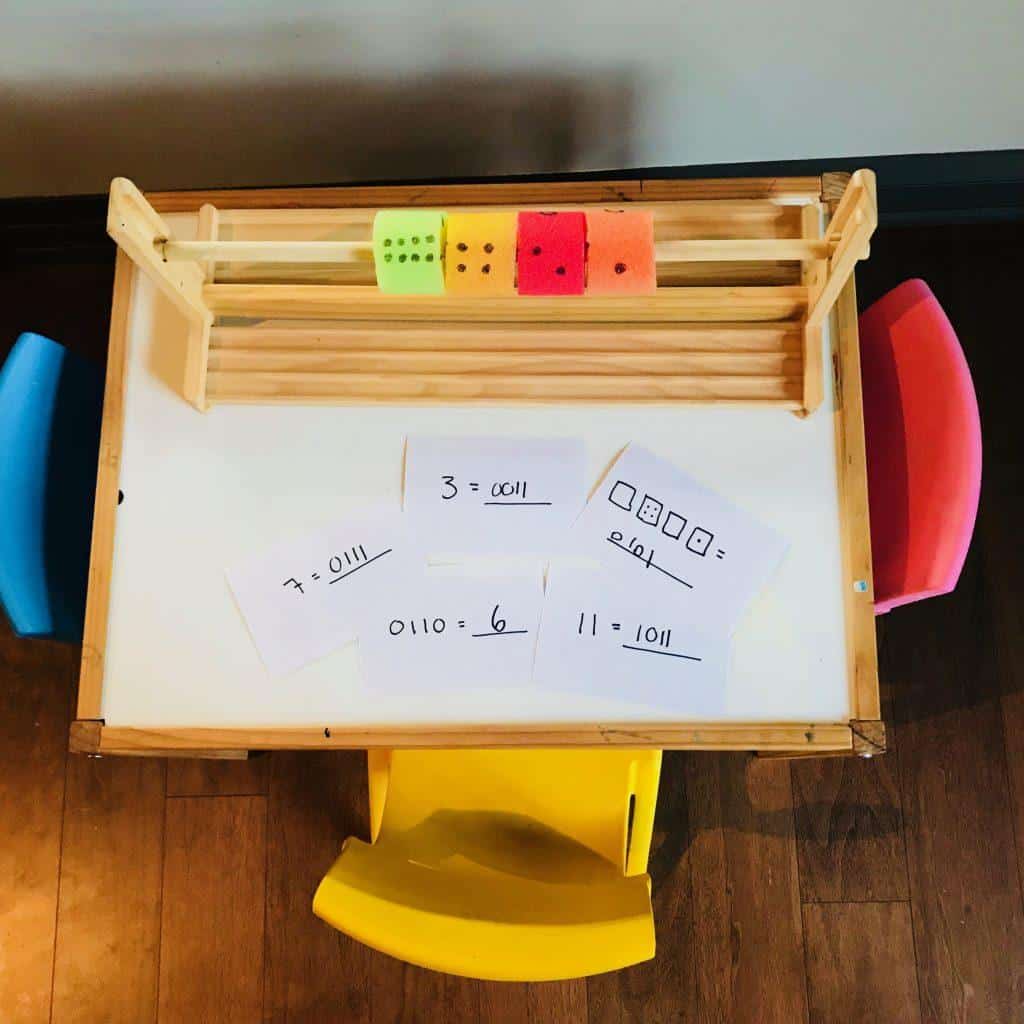
To learn more about Binary numbers, check out our simple activity meant for teaching kids binary numbers.
Binary and Computers
Computers are electronic devices that process data using a binary system. Binary is a numbering system that uses only two digits, 0 and 1. This system is used because computers are based on electronic circuits that can be either on or off, which corresponds to the binary digits 1 and 0. The binary system is used by computers to represent all kinds of data, including numbers, text, images, and sound.
The computer hardware that is responsible for processing data is called the Central Processing Unit (CPU). The CPU is made up of millions of tiny electronic circuits that can switch on and off very quickly. These circuits are organized into logic gates, which perform basic logical operations such as AND, OR, and NOT. Logic gates are used to perform arithmetic and logical operations on binary numbers.
The CPU uses a type of memory called Random Access Memory (RAM) to store data temporarily while it is being processed. RAM is made up of millions of tiny electronic circuits that can store binary digits. The CPU reads data from RAM and writes data to RAM very quickly, which allows it to process data at very high speeds.
Binary numbers are also used to represent text in computers. The American Standard Code for Information Interchange (ASCII) is a widely used encoding system that represents text using binary numbers. Each character in the ASCII code is represented by a unique combination of 7 or 8 binary digits.
Conversion Between Binary and Decimal
Binary numbers are a base-2 number system that uses only two digits, 0 and 1, to represent all numbers. On the other hand, decimal numbers are a base-10 number system that uses ten digits, 0 through 9, to represent all numbers. While binary numbers are commonly used in computer science and digital electronics, decimal numbers are used in everyday life.
Converting binary numbers to decimal numbers is a straightforward process. To convert a binary number to a decimal number, we need to multiply each digit of the binary number by the corresponding power of 2 and add up the results. For example, to convert the binary number 1011 to a decimal number, we can follow these steps:
- Starting from the rightmost digit, the first digit is 1, which represents 2^0 = 1.
- The second digit is 1, which represents 2^1 = 2.
- The third digit is 0, which represents 2^2 = 4.
- The fourth digit is 1, which represents 2^3 = 8.
Adding up the results, we get 1 + 2 + 0 + 8 = 11. Therefore, the decimal equivalent of the binary number 1011 is 11.
Converting decimal numbers to binary numbers is a bit more complicated. One method to convert decimal numbers to binary numbers is to use the double division method. This method involves dividing the decimal number by 2 and writing down the remainder. The quotient is then divided by 2 again, and the remainder is written down again. This process is repeated until the quotient is 0. The remainders, in reverse order, represent the binary equivalent of the decimal number.
For example, to convert the decimal number 27 to a binary number, we can follow these steps:
- Divide 27 by 2. The quotient is 13, and the remainder is 1.
- Divide 13 by 2. The quotient is 6, and the remainder is 1.
- Divide 6 by 2. The quotient is 3, and the remainder is 0.
- Divide 3 by 2. The quotient is 1, and the remainder is 1.
- Divide 1 by 2. The quotient is 0, and the remainder is 1.
Writing down the remainders in reverse order, we get the binary equivalent of the decimal number 27, which is 11011.

Mathematical Operations in Binary
Binary numbers are used in various digital systems, and it is crucial to understand how to perform mathematical operations on them. The basic mathematical operations – addition, subtraction, multiplication, and division – can be performed on binary numbers, just like on decimal numbers.
Binary Addition
Binary addition is similar to decimal addition, except that it uses a base of 2 instead of 10. The addition table for binary numbers is as follows:
To add two binary numbers, we start from the right-most digit and add the two digits. If the sum is 0 or 1, we write it down. If the sum is 2, we write down 0 and carry over 1 to the next digit. For example, to add 1011 and 1101:
   1 0 1 1
 + 1 1 0 1
 ---------
  1 0 0 1 0
 ---------
Binary Subtraction
Binary subtraction is similar to decimal subtraction, except that it uses a base of 2 instead of 10. The subtraction table for binary numbers is as follows:
To subtract two binary numbers, we start from the right-most digit and subtract the second digit from the first. If the difference is 0 or 1, we write it down. If the difference is -1, we write down 1 and borrow 1 from the next digit. For example, to subtract 1101 from 1011:
     1 0 1 1
   - 1 1 0 1
   ---------
     1 1 1 0
   ---------
Binary Multiplication
Binary multiplication is similar to decimal multiplication, except that it uses a base of 2 instead of 10. To multiply two binary numbers, we multiply each digit of the second number with the first number and add the results. For example, to multiply 1011 and 1101:
        1 0 1 1
      x 1 1 0 1
      ---------
        1 0 1 1
      1 0 1 1
    0 0 0 0
  1 0 1 1
  -------------
  1 1 1 0 0 1
  -------------
Binary Division
Binary division is similar to decimal division, except that it uses a base of 2 instead of 10. To divide two binary numbers, we use long division. For example, to divide 1011 by 11:
      1 0 1 1
    ---------
  1 1 )1 0 1 1
      1 1
      ---
      1 0
      1 1
      ---
         1
Power of 2
Binary numbers are often used in computer systems because they can be represented using a series of 0s and 1s. Each digit in a binary number represents a power of 2. The right-most digit represents 2^0, the second-right-most digit represents 2^1, the third-right-most digit represents 2^2, and so on. For example, the binary number 1011 represents 1 x 2^3 + 0 x 2^2 + 1 x 2^1 + 1 x 2^0 = 8 + 0 + 2 + 1 = 11.
Frequently Asked Questions
Binary numbers are a numeric system that uses only two digits, 0 and 1, to represent all numbers and data. Each digit in a binary number carries a value of either 0 or 1, and by combining these digits, any decimal number can be represented.
The sequence “11111111” in binary represents the decimal number 255. It is the largest 8-bit binary number, where each digit is set to 1, resulting in the maximum value in the range.
Binary can be explained to a child by using visual aids such as blocks or beads to represent the digits 0 and 1. By arranging these blocks or beads in different combinations, the child can learn to count in binary. For example, one block or bead represents 1, two blocks or beads represents 10, three blocks or beads represents 11, and so on. See our binary numbers activity for kids here.
Binary numbers are represented by 1 and 0 because these are the simplest and most basic symbols that can be used to represent two distinct states. In computing, these two states are often represented by on/off or true/false, which can be represented by 1 and 0 respectively.
Binary numbers are used extensively in computing and digital electronics to represent and manipulate data. They are also used in cryptography, where they are used to represent and manipulate secret keys and other sensitive information.
The binary number system is a base-2 numeral system that uses only two digits, 0 and 1, to represent all numbers and data. It works by assigning a place value to each digit, with each position representing a power of 2, allowing for the representation of any decimal number by combining the appropriate binary digits.

Kate is mom of two rambunctious boys and a self-proclaimed super nerd. With a background in neuroscience, she is passionate about sharing her love of all things STEM with her kids. She loves to find creative ways to teach kids computer science and geek out about coding and math. She has authored several books on coding for kids which can be found at Hachette UK.


