

Coding for Young Children: Introduce Coding Concepts at a Young Age!
This post may contain affiliate links. As an Amazon Associate, I earn from qualifying purchases.
Ddi you know that kids as young as preschool age can learn the basics of coding? While they are a bit too young to understand complex coding, there are many precoding skills they can learn. In this article, you will find four easy 打开色情网站 that will teach your preschooler the basic concepts of coding.
How Can We Introduce Coding to Young Children?
Coding is a language that both humans and computers understand. For computers to understand what humans want them to do, we must develop a way to communicate with them. This is done through computer 看片网站. A simple way to explain this is that computer programmers create a set of step-by-step instructions that tell the computer what the human wants it to do.
Pre-Coding Concept #1: Sequencing
Computers read a series of instructions in sequence. This is a perfect first step in teaching coding to preschoolers because, developmentally, they are learning how to follow multi-step directions themselves. Here is a quick and easy way to teach sequencing to preschoolers:

Pre-Coding Activity: Sequencing Hide-n-Seek
Materials Needed: a handful of small toys
Objective: follow a set of directions to find a hidden toy
Directions:
- Hide a toy in an area that is close to your child, but so the toy is out of sight.
- Establish a starting point.
- An adult gives verbal directions, one step at a time, to the child. Ex., “Take one step forward.”
- The child follows the direction.
- The adult gives the next direction.
- The child follows the direction.
- Repeat until the child is at the toy.
Variations: Instead of giving one step at a time, try giving two or three steps at one time. See if the child can do all three steps without help.
Notes: If the child makes the wrong move, refrain from correcting the child. This is a learning opportunity and something a computer programmer does regularly called “debugging” the program. So, if the child was directed to move three steps forward and then one to the right, and the child moves two forward and one to the right, they will be close to the toy but not exactly where the toy is. This is an opportunity to come back to the beginning and try the program again, listening very closely to the directions.
Pre-Coding Concept #2: Decomposing
秘密教学 is breaking down a complex problem into simple, manageable steps. Computers decompose problems before they can solve complex problems. An easy way to explain this to young children is to work backward, taking apart something that is complete to reveal its steps or parts.
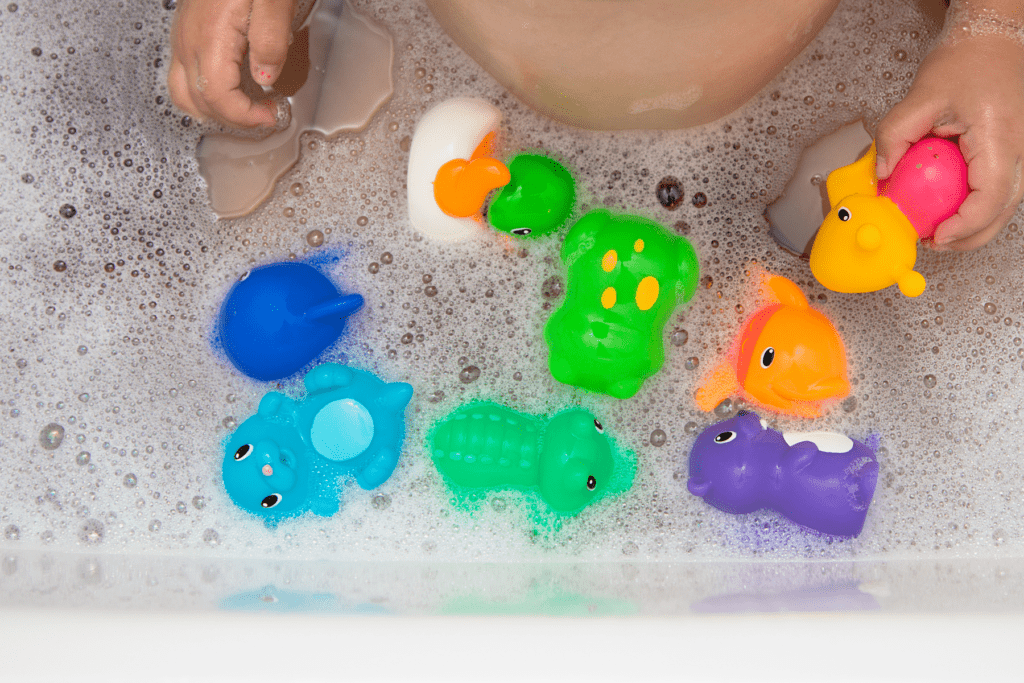
Pre-Coding Activity: Getting Ready for the Bath
Materials Needed: a clothed child or a doll with removable clothes
Objective: decompose or break apart the steps needed to get ready for the bath.
Directions:
- Ask the child (fully clothed), “What do you need to do before you can get in the bath?”
- Keep repeating the same question until they are ready for the bath.
Examples of things they may say are:
- “Take my shirt off.”
- “Take my pants off.”
- “Take my underwear off.”
- “Go to the bathroom.”
Variations: This activity can be repeated with other similar routines, such as getting ready for bed, brushing teeth, making a peanut butter and jelly sandwich, or building a car from blocks.
Pre-Coding Concept #3: Bug and Debugging
When writing code, programmers often run into problems or “bugs” in the program and have to fix or “debug” the program. Preschoolers can practice identifying bugs and then debugging them through play and everyday situations.
Pre-Coding Activity: My Boat is Sinking
Materials Needed: one piece of aluminum foil, a cup of pennies (about 50–100), and a bucket of water
Objective: make a boat from foil that will hold the most pennies
Directions:
- Introduce the challenge to your child. Can we build a boat from foil that will hold the most pennies?
- Help your child build a boat from the foil.
- Test the boat by placing it on the water and adding one penny at a time until it sinks.
- Encourage your child to think about where the weak spots were in the boat and how they might fix those. By identifying the weak spots, they are identifying a problem. This is what programmers do when coding. If they are able to come up with a solution to the problem they identified, this is the same as debugging a program and will help them later on when they start coding.
- Improve the boat design and test again. If the boat was able to hold more pennies, then your improvement worked, and you pseudo-debugged the program.
Pre-Coding Concept #4: If/Then Statements
If/then or conditional statements in coding refer to the idea that if one thing happens, then another thing will happen. It is the computer’s way of making decisions. Reading the book If You Give a Mouse a Cookie (or any book in that series) by Laura Numeroff is an easy way to introduce the coding skill of if/then statements.

Pre-Coding Activity: If/Then Number Hop
Materials Needed: sidewalk chalk, die, and an area like a driveway or sidewalk to play on
Objective: hop to the finish line based on if/then statements
Directions:
- Draw a large number line on a sidewalk or driveway using sidewalk chalk.
- The child will stand at 0. The adult will roll a die. If the number is even (2,4,6), then the child will hop forward one number on the number line. If the number is odd (1,3,5), then the child will hop backward one number on the number line.
- When you get to the finish line, you are done.
Variations: Make it a two-player game by drawing a second number line with chalk. Player one only gets to hop forward when the even numbers are rolled, and player two only gets to move forward when an odd number is rolled. The first person to the finish line wins!
The prerequisite skills needed for coding can easily apply to many preschool situations that come up in daily routines and play. Hopefully, these four easy ways for young children to learn coding skills are helpful in building the foundation necessary to learn computer coding later.

Kate is mom of two rambunctious boys and a self-proclaimed super nerd. With a background in neuroscience, she is passionate about sharing her love of all things STEM with her kids. She loves to find creative ways to teach kids computer science and geek out about coding and math. She has authored several books on coding for kids which can be found at Hachette UK.


